
标签:des style http color os io strong 数据
Description
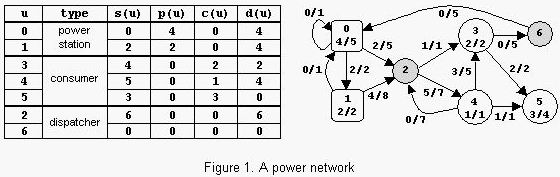
Input
Output
Sample Input
2 1 1 2 (0,1)20 (1,0)10 (0)15 (1)20
7 2 3 13 (0,0)1 (0,1)2 (0,2)5 (1,0)1 (1,2)8 (2,3)1 (2,4)7
         (3,5)2 (3,6)5 (4,2)7 (4,3)5 (4,5)1 (6,0)5
         (0)5 (1)2 (3)2 (4)1 (5)4
Sample Output
15
6
Hint
#include <stdio.h>
#include <string.h>
#include <stdlib.h>
#include <algorithm>
#include <iostream>
#include <queue>
using namespace std;
#define inf  9999999999
int flow[210][210];
int maxflow[210],father[210],vis[210];
int max_flow;
int m,i;
void EK(int s,int e)
{
    queue<int >q;
    int u,v;
    max_flow=0;
    while(1)
    {
        memset(maxflow,0,sizeof(maxflow));
        memset(vis,0,sizeof(vis));
        maxflow[s]=inf;
        q.push(s);
        while(!q.empty())
        {
            u=q.front();
            q.pop();
            for(v=s;v<=e;v++)
            {
                if(!vis[v]&&flow[u][v]>0)
                {
                    vis[v]=1;
                    father[v]=u;
                    q.push(v);
                    maxflow[v]=min(maxflow[u],flow[u][v]);
                }
            }
            if(maxflow[e]>0)
            {
                while(!q.empty())
                    q.pop();
                break;
            }
        }
        if(maxflow[e]==0)
            break;
        for(i=e;i!=s;i=father[i])
        {
            flow[father[i]][i]-=maxflow[e];
            flow[i][father[i]]+=maxflow[e];
        }
        max_flow+=maxflow[e];
    }
}
int main()
{
    int n,np,nc,m;
	int i,a,b,c;
	char ch;
	while(~scanf("%d%d%d%d ",&n,&np,&nc,&m))//输入注意后面的空格
	{
		memset(flow,0,sizeof(flow));
		for(i=1;i<=m;i++)
		{
			scanf("(%d,%d)",&a,&b);
			scanf("%d ",&c);//注意后面的空格
			flow[a+1][b+1]=c;
		}
		for(i=1;i<=np;i++)//建立总源点
		{
			scanf("(%d)%d ",&a,&b);//注意后面空格
			flow[0][a+1]=b;
		}
		for(i=1;i<=nc;i++)//建立总汇点
		{
            scanf("(%d)%d ",&a,&b);//注意后面的空格
			flow[a+1][n+1]=b;
		}
		EK(0,n+1);
		printf("%d\n",max_flow);
	}
	return 0;
}
Power Network(最大流基础_增广路算法:多源多汇,自建总源点和总汇点),布布扣,bubuko.com
Power Network(最大流基础_增广路算法:多源多汇,自建总源点和总汇点)
标签:des style http color os io strong 数据
原文地址:http://blog.csdn.net/u013486414/article/details/38670053
