
安装
Django是以Python为语言环境的,所以要先确保计算机上已经安装了Python。
Linux
ubuntu:
sudo pip install Django==1.11.7
安装中指定了版本,可以修改版本号,或者不指定将安装软件源中已有的版本。
安装完成后,可以进入到Python交互模式中查看版本:
>>> import django
>>> print(django.get_version())
1.11.7
上面是简单而常用的方法,除了这种方法,还可以下载Django的源码进行安装:
git clone https://github.com/django/django.git
此时会在当前目录中看到一个名为django的目录,里面是最新版本的Django,随后在当前目录下执行如下操作:
sudo pip install -e ./django
系统会提示Django已经安装成功的信息:"Successfully installed Django"。
Windows
在cmd中执行:
pip install django==1.11.7
创建项目
方法一:
λ django-admin startproject mysite
λ tree /f
D:.
└─mysite
    │  manage.py
    │
    └─mysite
            settings.py
            urls.py
            wsgi.py
            __init__.py
方法二,在项目名称mysite后面有一个空格,然后还有一个句号(英文半角句号),如此也可以创建项目,只不过是在当前文件夹下创建。
λ django-admin startproject mysite .
λ tree /f
D:.
│  manage.py
│
└─mysite
        settings.py
        urls.py
        wsgi.py
        __init__.py
启动服务
进入与manage.py同目录下执行:
python manage.py runserver
会看到如下信息:
Starting development server at http://127.0.0.1:8000/
Quit the server with CTRL-BREAK.
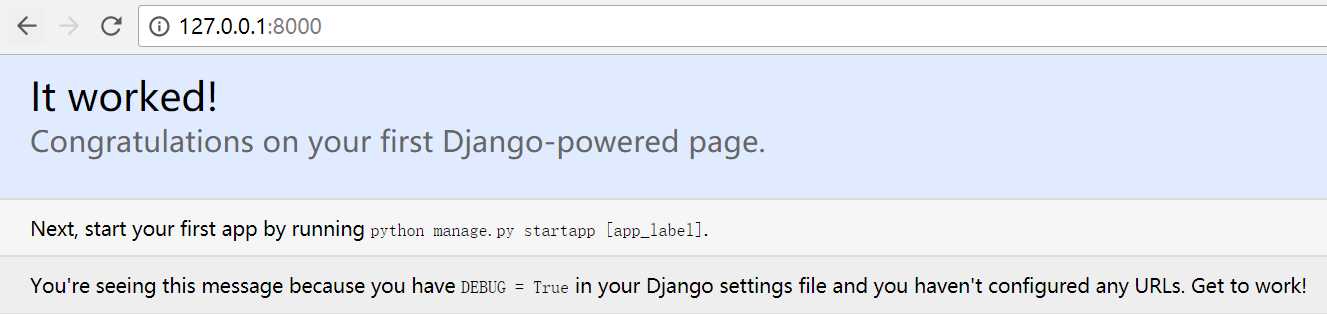
此时再浏览器中输入http://127.0.0.1:8000/ 或者http://localhost:8000/,就会看到如下图所示的结果。
创建应用
项目已经创建好了,网站也有了,接下来要实现网站的具体功能,在Django中,人们把这些具体的功能称之为‘‘应用‘‘(application)。
λ python manage.py startapp blog
λ tree /f
D:.
│  db.sqlite3
│  manage.py
│
├─blog
│  │  admin.py
│  │  apps.py
│  │  models.py
│  │  tests.py
│  │  views.py
│  │  __init__.py
│  │
│  └─migrations
│          __init__.py
│
└─mysite
    │  settings.py
    │  urls.py
    │  wsgi.py
    │  __init__.py
    │
    └─__pycache__
            settings.cpython-36.pyc
            urls.cpython-36.pyc
            wsgi.cpython-36.pyc
            __init__.cpython-36.pyc
下面对生成的文件进行简要说明
Django的任务管理命令行工具 django-admin.py
λ django-admin

Type ‘django-admin help <subcommand>‘ for help on a specific subcommand.

Available subcommands:

[django]
    check
    compilemessages
    createcachetable
    dbshell
    diffsettings
    dumpdata
    flush
    inspectdb
    loaddata
    makemessages
    makemigrations
    migrate
    runserver
    sendtestemail
    shell
    showmigrations
    sqlflush
    sqlmigrate
    sqlsequencereset
    squashmigrations
    startapp
    startproject
    test
    testserver
查看帮助信息:
D:\lcg\mysite
λ django-admin help startapp
usage: django-admin startapp [-h] [--version] [-v {0,1,2,3}]
                             [--settings SETTINGS] [--pythonpath PYTHONPATH]
                             [--traceback] [--no-color] [--template TEMPLATE]
                             [--extension EXTENSIONS] [--name FILES]
                             name [directory]

Creates a Django app directory structure for the given app name in the current
directory or optionally in the given directory.

positional arguments:
  name                  Name of the application or project.
  directory             Optional destination directory

optional arguments:
  -h, --help            show this help message and exit
  --version             show program‘s version number and exit
  -v {0,1,2,3}, --verbosity {0,1,2,3}
                        Verbosity level; 0=minimal output, 1=normal output,
                        2=verbose output, 3=very verbose output
  --settings SETTINGS   The Python path to a settings module, e.g.
                        "myproject.settings.main". If this isn‘t provided, the
                        DJANGO_SETTINGS_MODULE environment variable will be
                        used.
  --pythonpath PYTHONPATH
                        A directory to add to the Python path, e.g.
                        "/home/djangoprojects/myproject".
  --traceback           Raise on CommandError exceptions
  --no-color            Don‘t colorize the command output.
  --template TEMPLATE   The path or URL to load the template from.
  --extension EXTENSIONS, -e EXTENSIONS
                        The file extension(s) to render (default: "py").
                        Separate multiple extensions with commas, or use -e
                        multiple times.
  --name FILES, -n FILES
                        The file name(s) to render. Separate multiple
                        extensions with commas, or use -n multiple times.
manage.py
D:\lcg\mysite
λ python manage.py

Type ‘manage.py help <subcommand>‘ for help on a specific subcommand.

Available subcommands:

[auth]
    changepassword
    createsuperuser

[contenttypes]
    remove_stale_contenttypes

[django]
    check
    compilemessages
    createcachetable
    dbshell
    diffsettings
    dumpdata
    flush
    inspectdb
    loaddata
    makemessages
    makemigrations
    migrate
    sendtestemail
    shell
    showmigrations
    sqlflush
    sqlmigrate
    sqlsequencereset
    squashmigrations
    startapp
    startproject
    test
    testserver

[sessions]
    clearsessions

[staticfiles]
    collectstatic
    findstatic
    runserver
与django-admin进行对比,发现代码有一部分相同,同时manage.py还有自己的特点。
django-admin命令对应着django-admin.py文件,她在Django安装后保存在Django安装目录下。(windows的C:\Python36\Scripts,linux的/bin)
而manage.py只是建立了一个项目之后,才保存于项目的根目录之中。
可以说manage.py是对django-admin的简单封装。
关于两者的更多辨析,请参阅官方文档:https://docs.djangoproject.com/en/1.11/ref/django-admin/
mysite
mysite是所建项目的管理功能目录,这个目录的名称因用户所创建的项目名称的不同而异,它里面的几个文件常用于向整个项目进行参数配置。
- settings.py:这个文件中包含了项目的初始化设置,可以针对整个项目进行有关参数的配置,比如配置数据库、添加应用等。
- urls.py:这是一个URL配置表文件,主要将URL映射到应用程序上,当用户请求某个URL时,Django项目会根据这个文件中的映射关系指向某个目标对象,该对象可以是某个应用的urls.py也可以是某个具体的视图函数。在Django中,这个文件也被称之为URLconf,这是Django非常强大的一个特性。
- wsgi.py:WSGI是Web Server Gateway Interface的缩写。WSGI是Python所选择的服务器和应用标准,Django也会使用。wsgi.py文件定义了我们所创建的项目都是WSGI应用。有关于WSGI的更多知识请参阅官方文档:https://wsgi.readthedocs.io/en/latest/index.html
- __pycache__:启动服务,浏览项目的时候产生的。不浏览就不会产生,只有网站运行后它才会出现,它其就是编译后的一个文件夹。里面都是以.pyc结尾的文件。
blog
blog是项目中所创建的项目之一,用创建项目的指令还可以创建很多其他的应用,每创建一个应用,Django都会在项目的根目录中创建一个子目录,并且目录中会有以下默认的文件:
